- October 16, 2026
- By: aahadmin
- in: Uncategorized


When it comes to material handling on Australian construction sites, choosing the right equipment can have a major impact on productivity, safety, and operating costs. Two of the most commonly compared machines are telehandlers and all terrain forklifts. While both are designed to move materials across rough and uneven ground, they are built for different applications and offer very different capabilities.
Understanding the strengths of each machine can help contractors, builders, and site managers select the right solution for their project requirements.
A telehandler, or telescopic handler, is a versatile lifting machine fitted with a telescopic boom that can extend forward and upward. Telehandlers are commonly used across construction, mining, infrastructure, agriculture, and industrial projects where lifting reach and flexibility are required.
Unlike a conventional forklift, a telehandler can:
Modern telehandlers can also be fitted with:
This versatility makes them one of the most widely used machines on Australian construction sites.
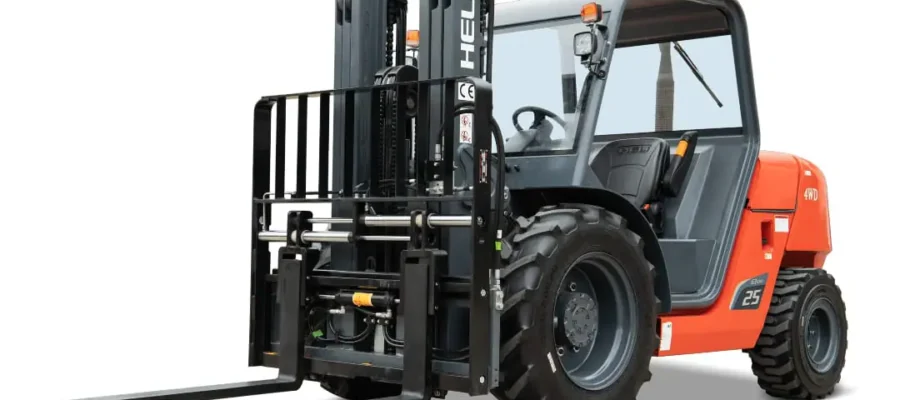
An all-terrain forklift is essentially a heavy-duty rough terrain forklift designed to operate on uneven ground and outdoor environments. It features:
Unlike telehandlers, all terrain forklifts use a traditional vertical mast system rather than a telescopic boom.
They are designed primarily for:
All terrain forklifts are commonly used on civil projects, precast yards, timber yards, and construction sites where materials need to be moved efficiently across rough surfaces.
The biggest difference between the two machines is lifting reach.
Telehandlers are specifically designed for:
This allows operators to place loads onto:
An all terrain forklift is more limited, as the mast only lifts vertically.
For projects involving multi-level construction, telehandlers are usually the preferred option.
Telehandlers offer significantly greater versatility thanks to their attachment compatibility.
A single telehandler may perform the work of:
This can reduce fleet requirements and improve overall site efficiency.
All terrain forklifts are more specialised machines focused primarily on pallet handling and transport.
Both machines perform well on rough terrain, but their strengths differ.
For highly congested construction environments, compact telehandlers are often more practical.
All terrain forklifts are often favoured for:
Because the load remains closer to the chassis, they can offer excellent stability for certain lifting applications.
Telehandlers may have reduced lifting capacity at full reach or maximum height due to load chart limitations.
Choosing the right machine depends on:
Both machines require trained operators and proper load management procedures.
Telehandlers require careful attention to:
All terrain forklifts require attention to:
Modern telehandlers often include:
There is no universal “better” machine — the right choice depends on the job.
For many Australian construction contractors, telehandlers provide greater flexibility and long-term value across a wider range of applications. However, all terrain forklifts remain highly effective for dedicated material transport tasks where reach and elevated placement are less important.
By understanding the operational differences between the two machines, construction businesses can improve productivity, enhance safety, and ensure the right equipment is selected for every stage of a project.
If you are looking to hire a telehandler or all-terrain forklift, please contact us and our helpful team of hire experts who will be happy to guide you through the rental process.

Since 2006, Australian Access Hire (AAH) has been Australia’s trusted partner for access equipment hire and rental. With branches in Sydney, Brisbane, Melbourne, and Perth, we deliver safe, reliable, and premium-brand solutions for every project.