- October 16, 2026
- By: aahadmin
- in: Uncategorized

When you need to move heavy materials around a construction site, two of the most common options are a telehandler and a forklift. Both are designed for lifting and transporting materials, but they have very different strengths.
Choosing between them isn’t simply about which machine can lift the most weight. The right choice depends on how high you need to lift, how far you need to reach, the terrain you’re working on, the space available and the type of materials you’re handling.
So, which is better for your construction project?
The answer depends on the job.
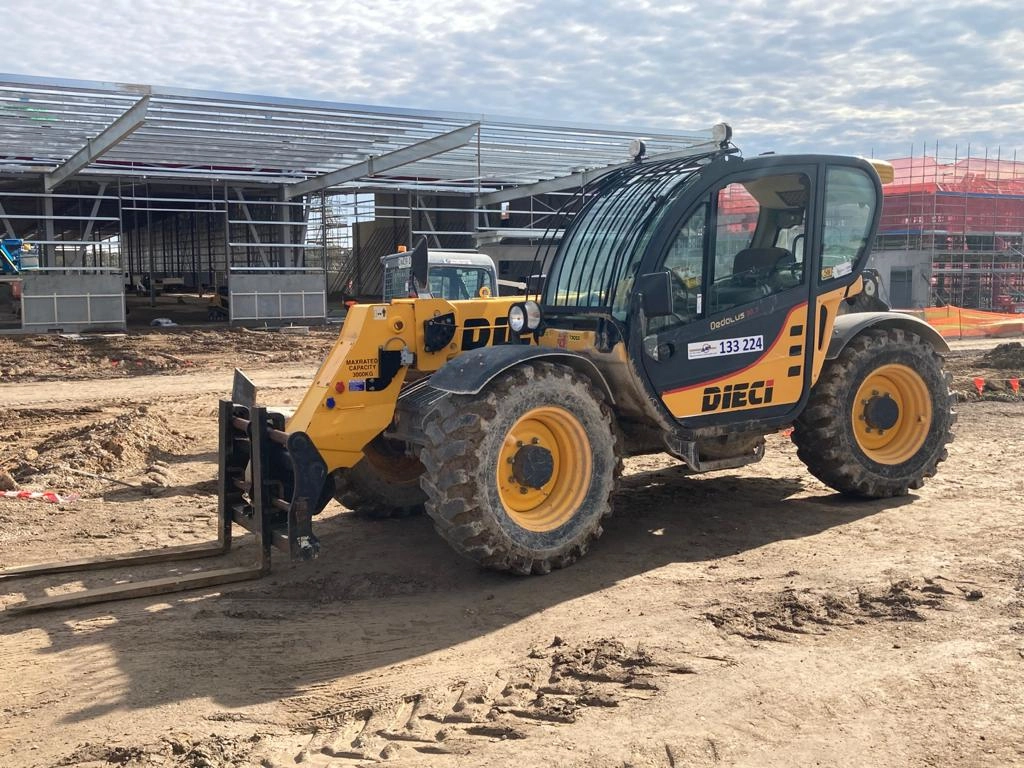
A telehandler, or telescopic handler, is a versatile material-handling machine fitted with a telescopic boom.
Unlike a conventional forklift, the boom can extend forwards and upwards, allowing the operator to lift and place materials at height and reach over obstacles.
Telehandlers can also be fitted with different attachments, including forks, buckets, jibs and other specialised equipment.
This makes them particularly useful on construction sites where materials need to be moved, lifted and positioned in different locations.
Telehandlers are available in a range of sizes and capacities, from relatively compact machines through to heavy-duty telehandlers designed for demanding lifting applications.
A forklift is primarily designed to lift, transport and position loads using fork tynes mounted at the front of the machine.
Forklifts are extremely effective when materials need to be moved over relatively short distances, particularly on firm, level surfaces.
They are commonly used for:
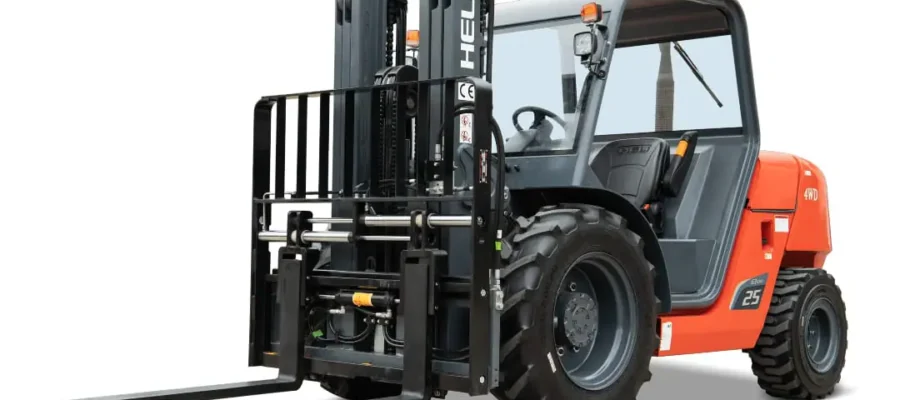
There are also specialised forklifts designed for rough terrain and outdoor construction applications, providing greater capability than the typical warehouse forklift.
However, even an all-terrain forklift doesn’t provide the same telescopic reach as a telehandler.
The biggest difference is reach and versatility.
A forklift generally lifts a load vertically in front of the machine. A telehandler can extend its boom forwards and upwards, allowing the operator to place loads considerably further away from the machine.
Think of a forklift as a highly effective load transporter and stacker.
A telehandler is more like a forklift with a telescopic boom, giving it significantly greater flexibility when materials need to be placed at height or over obstacles.
Here’s how they compare across some of the most important factors.
| Feature | Telehandler | Forklift |
|---|---|---|
| Vertical lifting | Excellent | Excellent |
| Forward reach | Excellent | Limited |
| Placing loads over obstacles | Excellent | Limited |
| Rough terrain | Excellent | Depends on model |
| Pallet handling | Excellent | Excellent |
| Loading trucks | Excellent | Excellent |
| High-level construction work | Excellent | More limited |
| Attachment versatility | Excellent | More limited |
| Tight indoor spaces | Depends on model | Often better |
| General material transport | Excellent | Excellent |
A telehandler is often the better option when your project requires reach, height and versatility.
Construction sites often require materials to be lifted to elevated positions.
A telehandler can lift materials and extend its boom to place them where they’re needed.
This can be particularly useful when working on:
The telescopic boom allows the operator to position materials without necessarily needing to drive directly underneath the placement point.
This is one of the biggest advantages of a telehandler.
Imagine you need to place a pallet on the other side of a wall or structure. A conventional forklift may not be able to reach far enough.
A telehandler can extend its boom forwards, allowing the operator to position the load beyond the machine’s normal lifting position.
This makes telehandlers particularly useful when reach is just as important as lifting capacity.
Construction sites aren’t always flat.
Mud, gravel, dirt, slopes and uneven surfaces can make material handling more challenging.
Telehandlers are designed for demanding outdoor environments and provide the ground clearance, traction and stability needed for many construction applications.
For particularly difficult terrain, choosing the right machine and configuration is important, as site conditions can have a significant effect on safe machine operation.
One of the biggest advantages of telehandler hire is versatility.
The same machine can potentially be used for several different tasks by changing attachments.
For example, forks can be used for pallets and packaged materials, while buckets can be used for loose materials. Jibs and hooks can provide additional lifting capabilities for suitable applications.
Instead of hiring several different machines for different material-handling tasks, a telehandler can potentially perform multiple roles.
A forklift can be the better option when your primary requirement is efficient material handling over relatively short distances.
If the majority of your work involves picking up pallets, transporting them and placing them down again, a forklift can be extremely effective.
Forklifts are designed specifically around this type of operation and can provide excellent manoeuvrability and productivity.
For example, if you’re unloading pallets from a truck and moving them to a nearby storage or work area, a forklift may be all you need.
If loads are generally being lifted directly in front of the machine, you may not need the additional reach provided by a telehandler.
A forklift can be a straightforward and efficient solution for moving materials around a defined work area.
Depending on the model, forklifts can be more compact and manoeuvrable than larger telehandlers.
This can make them particularly useful around:
If space is limited, consider the machine’s overall dimensions and turning radius before choosing your hire equipment.
If you’re mainly moving materials from A to B rather than lifting them high or reaching over obstacles, a forklift may be the more appropriate machine.
Not all forklifts are designed for warehouses.
All-terrain forklifts are specifically designed for outdoor applications and can be a highly effective option for construction sites, particularly where loads need to be transported across uneven ground.
They provide many of the benefits of a conventional forklift while being better suited to demanding outdoor environments.
However, they still operate differently from telehandlers.
The key question remains:
Do you need reach, or do you primarily need lifting and transport?
If your project involves moving pallets around a rough outdoor site, an all-terrain forklift could be an excellent choice.
If you need to extend the boom forwards to place materials at height or over an obstacle, a telehandler is likely to be more suitable.
Both machines can be used for loading and unloading trucks, but the right choice depends on the circumstances.
A forklift is extremely effective when the truck can be accessed directly and the load can be picked up and placed without requiring significant reach.
A telehandler becomes particularly useful when the truck, load or surrounding site conditions require greater reach or flexibility.
For example, a telehandler may be advantageous when working on an uneven construction site where the truck cannot be positioned directly alongside the material storage area.
Both machines can move building materials, but telehandlers have a major advantage when those materials need to be placed at height or reach across a construction site.
Telehandlers are commonly used for handling materials such as:
Forklifts are particularly effective when those materials are palletised and need to be transported and stacked efficiently.
The best choice therefore depends on what happens after you’ve picked up the load.
If the job is simply “pick it up and move it”, a forklift may be ideal.
If the job is “pick it up, drive across uneven ground, lift it several metres and place it over there”, a telehandler is likely to provide considerably more flexibility.
It’s important not to assume that a machine with a higher maximum lifting capacity is automatically the better choice.
Both forklifts and telehandlers have specific load limits, and a telehandler’s available capacity can change as the boom extends.
For example, a telehandler may have a high maximum lifting capacity when the boom is retracted, but its capacity will generally decrease as the boom extends and the load moves further away from the machine.
Always check the load chart for the specific machine and make sure it is suitable for the weight, height and reach required for your lift.
If you’re unsure, speak to your equipment hire provider before selecting the machine.
The attachment you use can also influence which machine is best suited to the job.
Forks are ideal for palletised materials, while buckets can be used for handling suitable loose materials. Jibs and hooks can provide additional lifting options for appropriate applications.
However, attachments aren’t interchangeable between every machine, and using an attachment can affect the machine’s rated capacity and operating characteristics.
When arranging equipment hire, explain exactly what you’re planning to lift and which attachment you need.
A simple way to think about it is:
And if you’re working outdoors on uneven ground but don’t need telescopic reach, an all-terrain forklift may be the ideal middle ground.
There’s no universal winner in the telehandler vs forklift debate.
Both machines have their place, and the right choice comes down to what your project actually requires.
If you’re primarily transporting and stacking palletised materials, a forklift can provide an efficient and practical solution.
If you need to lift materials higher, reach further, work across uneven terrain or use different attachments, a telehandler provides considerably greater versatility.
The most important thing is to choose equipment based on the actual requirements of the job rather than simply choosing the machine with the greatest capacity.
At Australian Access Hire (AAH), we offer a range of material-handling equipment for construction, industrial, civil and other demanding applications.
Whether you need a telehandler for high-reach material placement or an all-terrain forklift for moving heavy loads around a construction site, our team can help you find equipment suited to your project.
Not sure whether you need a telehandler or forklift? Contact AAH and tell us what you’re lifting, how high you need to lift it and what your site is like. We’ll help you determine which type of equipment is best suited to the job.
Neither machine is universally better. A telehandler is generally better when you need forward reach, high-level placement and attachment versatility, while a forklift can be more efficient for pallet handling, stacking and transporting materials over shorter distances.
For many applications, a telehandler can perform tasks normally handled by a forklift, particularly when fitted with forks. However, a telehandler isn’t always the most efficient choice for every material-handling job. If you’re primarily moving pallets around a confined area, a forklift may be more suitable.
Yes. Telehandlers are particularly well suited to construction because they combine lifting capacity, telescopic reach and off-road capability. They can be used to move and place materials across uneven sites and at elevated positions.
Some forklifts are specifically designed for outdoor and rough-terrain applications. All-terrain forklifts can be suitable for construction sites where loads need to be transported across uneven or unsealed surfaces.
The biggest advantage is versatility. A telehandler combines lifting capability with telescopic forward reach and can often use a range of attachments, allowing one machine to perform multiple material-handling tasks.
Consider the weight of your heaviest load, required lift height, forward reach, ground conditions, site access and attachment requirements. If you’re unsure, speak with your equipment hire provider before choosing a machine.

Since 2006, Australian Access Hire (AAH) has been Australia’s trusted partner for access equipment hire and rental. With branches in Sydney, Brisbane, Melbourne, and Perth, we deliver safe, reliable, and premium-brand solutions for every project.
CALL OUR TEAM
133 224